

24 February 2026
A Snowy Day Outside the Prison, Among the Families of the Detained
Mahdis Fakhari
When it snows, what does a person think about?
A farmer thinks of his crops. A carpenter, of his timber. The driver who must take to the road thinks of his car, of traffic, of the long miles ahead. The one who must leave home for school, university, or work thinks of the path before them.
And the one with someone in prison thinks of their imprisoned loved one: Do they know it’s snowing? How are they bearing the cold? Is the cell warm enough? Is there even a window through which they can see the falling snow?
Perhaps very few people think of those who stand outside prison walls, in bitter weather, waiting for a word, a visit, a hopeful sign from their loved ones locked away inside. When it snows, the families of those in prison are the ones most easily forgotten.
I had arranged with a couple of friends to go, one morning, to the gates of Evin Prison, simply to stand with the family of our friend behind bars, if only to offer a little encouragement, to let them know they were not alone, not abandoned in their vigil. We hoped to help with whatever they needed: to hand out cups of hot tea and something to eat to those waiting at the doors.
On the day we had planned to go, the snow began to fall. Messages flew back and forth: Should we still go? Should we wait for better weather? One friend said, “No, this is exactly when we should go. It may be hard for us, but the families are there alone.”
And so, despite the snow, we got into the car and drove to Evin.
A friend of mine had been arrested during one of the street protests - caught while writing a slogan on a wall. For the first two weeks, his family searched everywhere, not knowing where he had been taken. They were fortunate that one of his friends had witnessed the arrest; otherwise, their search might have led them all the way to the morgues. For those two weeks, they wandered from police stations to courthouses, from one detention centre to another, receiving no straight answers. Then, at last, he called and said he was in Evin.
The morning we went to stand outside the prison, a month had passed since his arrest. By the time we reached Evin, the snow was falling harder. We parked the car, stepped out, and slowly made our way up the road toward the large group of people gathered at the gate. We spotted his mother, father, and sister almost immediately - their faces and hands flushed red beneath layers of heavy clothing. They had been there since eight in the morning. Some had arrived as early as seven, hoping their loved one might be released a little sooner.
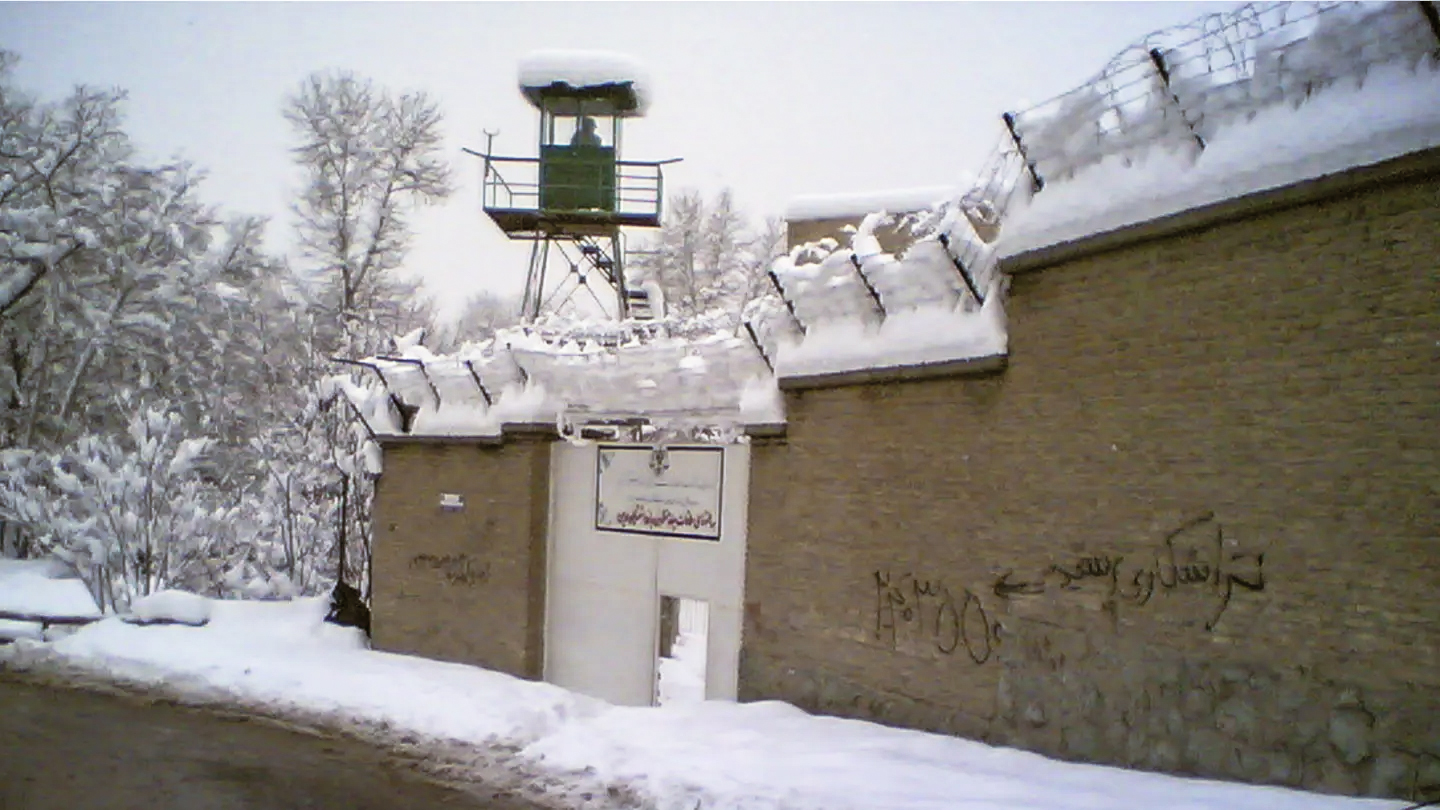
Everyone stood outside in the cold, snow on their coats, their breath turning the air before their faces into mist. A barred metal gate blocked the entrance, and a few metres behind it stood a second iron door. Every so often, a soldier would emerge from the iron door, call out a name from behind the bars, offer a scrap of news, or let one person slip through.
It felt like the days of 2009 all over again. Back then, too, families were barred from entering the courthouse and had no choice but to sit for hours on the kerb by the bridge or lean wearily against its concrete wall. I think it was the following year that they finally built a waiting hall for Evin’s courthouse - about fifty chairs lined up in rows, where families of the detained would hand over their mobile phones at the entrance and then be allowed inside. There, they could sit and speak with the soldiers stationed behind a desk, who would call upstairs and relay whatever message they could.
Even in that hall one might wait for hours. The interrogating officer might not answer, might not even be present, and the soldiers’ refrain - “Go home, we’ll call you ourselves”—hung constantly in the air. But at least the cold didn’t cut to the bone. At least your hands and feet didn’t go numb, and your strength wasn’t drained before the day had even begun. Waiting takes energy too, and in weather like this, waiting becomes an ordeal—an agony filled with dark imaginings.
What have they done to my loved one? What state is he in now? Does he know I’m here, close by, just beyond these walls? Does he think I’ve forgotten him? That I’m not searching for him? Have they forced a confession? What verdict is looming over him? Does he know I’m behind him with all I have, that I don’t blame him for anything?
Sometimes you want to shout, just to let your voice reach him. To let him know you’re near, so he might take heart. You want to call his name, cry it into the cold air, hoping your voice might slip through these doors and walls, across the prison yard and past the tall trees, and somehow find him.
For days, my friend’s family had been told to bring the bail papers, yet each time they came, no one would accept them. The interrogating officer isn’t here, they were told. He’s on leave. In all this time, my friend had managed only three or four brief phone calls, and even then, no visits were allowed. As for appointing a lawyer, there was no point even thinking about it.
What exactly is he charged with? They hadn’t said, and they wouldn’t let him say it over the phone. Someone stood beside him during each call, and the moment he tried to offer any detail, the line went dead. In such a place, the very words hearingand trial have been emptied of meaning, and in the face of so much arbitrary injustice one feels utterly defenceless. A wall covered in snow offers no comfort to lean your head against, no solace for a helpless sigh.
That day, several families, including my friend’s mother and father, had brought the bail documents once again. The soldier told many of them to leave, to stop waiting around, but they stayed—because sometimes, in the midst of waiting, something unexpectedly moves: a bit of news, a chance to go inside, a brief conversation with the interrogating officer, or the opportunity to hand over the deed to one’s home.
That day was no different. They were told to go home and return tomorrow, yet they remained in place, hoping they might be allowed to submit the deed after all, hoping the wheels of bureaucracy might turn just enough for the collateral to be accepted, and for their loved one to be released on bail.
We stood beside them. There was nothing else we could do. We couldn’t make up news out of thin air to lift their spirits. So, we stood there, held their hands, and offered words of encouragement - frail, uncertain words that carried no guarantees.
We had even hesitated to bring a thermos of tea and sandwiches. It’ll draw attention, we thought. The security forces might come after us. Plainclothes agents might spot us in the crowd and make trouble. Some of our friends had already been arrested simply for helping the families of detainees. These days, the slightest gesture could be twisted into an accusation. So, we decided to go this time empty-handed, to ask around and see whether, next time, we might safely bring the tea.
We spoke with several other families too - with the sister of one detainee, the husband of another, and with mothers and fathers whose eyes carried the weight of sleepless nights. One had been arrested in the street, another pursued and cornered in their home; someone’s spouse had been detained for Instagram stories, another betrayed by a neighbour or colleague.
Every voice sounded worn down, anxious, yet eager to speak - eager to share their story, to share even a fraction of the pain they had been carrying in silence.
Going to Evin is not easy. There’s no metro station nearby, no bus line to drop you at its gates. You have to change taxis several times, or rely on a ride-hailing car. And those who must travel to other prisons - to Fashafuyeh, to Qarchak, to the Greater Tehran Prison - face far greater hardship. When it snows, the ride-hailing apps shut down, and shared taxis all but disappear.
These days, perhaps the greatest kindness one can offer someone with a loved one in prison is simply to arrange transport. I’ve heard it from many: if you want to help, this is the best way. So, we must stay in touch with the families. There are so many people detained that almost everyone knows someone in prison. We can’t wait until prisoners are freed to show our support. We can begin by caring for their families.
To imprison someone is not only to imprison them—it is to confine their family as well, to leave them scattered, exhausted, exposed. Yet when the snow falls, few think of those who stand in bitter cold, waiting behind iron bars for a sliver of news, a moment of relief, a single step toward freedom.