

24 February 2026
Our Mothers Have Never Given Up on Their Dreams
Khadija Haidari
In Afghanistan, the age gap between a mother and her first daughter rarely exceeds twenty years. My mother and I are nineteen years apart. During those nineteen years—from 1972 to 1991—Afghanistan scarcely took a breath of peace. There was always a war somewhere, and for my mother, that meant no chance to go to school.
As she and her peers tell it, the endless, suffocating conflicts kept them away from classrooms. At night, they fled with Qur’ans pressed to their chests, hiding in mountain caves while bombs fell, praying they could return alive by morning. That was their childhood - a cycle of escape and survival. As the elders used to say, “their minds grew dull and their learning impossible.” The best path for a girl, they thought, was to “start her life”, meaning, to marry and bear children.
My mother still recalls those nights of flight vividly. One woman would recite Surah Yaseen aloud in the cave, and my mother, a young girl clutching her own Qur’an, learned to whisper along. She remembers every verse she memorised then. There were moments of calm when she managed to attend a small religious class and study the Qur’an. She had a sharp mind, quick to grasp her own lessons and those of other girls too. But when my father came to ask for her hand, that brief season of schooling ended. To this day, her education remains the final section of the Qur’an - the thirtieth juz’, which she recites flawlessly in prayer, her voice steady and clear in gatherings of women.
I was born in the midst of war. Our village was pounded by rockets almost daily. In every home, two brothers often followed two rival commanders - each loyal to a different faction -and families were torn apart. When I finally started school, fighting resumed before I finished my second year, forcing us to flee to another district for a year. We returned the next spring, and from third grade to twelfth I studied without interruption. I learned English, devoured hundreds of novels, and discovered the joy of books my mother had never known.
Sometimes she would ask simple questions, full of wonder: “How do you sit in school?”
“There are benches,” I’d explain. “Three girls share a long seat with a desk in front.”
She couldn’t picture it until one day she saw a classroom on television. After that, she never asked again.
While we studied, she was always washing clothes, cooking, tending to my younger siblings. She had accepted that her time for learning had passed - that it was now her children’s turn. Perhaps, in some quiet way, our education felt like her own. She has never asked us to teach her to read or write. Maybe she believes that through her daughters she has already fulfilled her dream - that literacy is finally alive in her home. Yet I know there are moments, in the middle of her chores, when she pauses and thinks: If only I had had the chance to learn, to think, to be something more.
My mother-in-law’s story follows a similar path, only more entangled with war and displacement. Just twenty years older than her first child, she was born in a northern village, lost her father at twelve - the year of Daoud Khan’s coup - and grew up an orphan. She rarely speaks of school; instead, she talks about the years spent stitching embroidery, surviving on her own until she married at nineteen.
Her husband, an educated man, encouraged her to learn to read the Qur’an. Soon, though, children came, and then the family fled to Pakistan. Life in the refugee camps of Shamshatoo - the tents, the blistering summers - left little room for study. Her days were consumed with raising the children.
Years later, back in Afghanistan and then again in exile in Iran, she sent all her children to school. The old dream of learning returned, and she asked her husband for permission to attend an adult literacy class. His answer stayed with her for years: “Be patient. Let the children finish their studies first. When they grow up, I’ll teach you myself.”
She waited, for a long time. Then one day, no longer able to wait, she enrolled in a literacy course on her own. She learned quickly, finishing first in her class. She joined a small religious school too, learning to read the Qur’an properly. For her, being able to read shop signs and recite scripture after decades of illiteracy - and after raising ten children - was a triumph. Upon returning to Afghanistan, she became known in prayer gatherings for her melodious recitation and was even handed the microphone to lead the group.
Wherever life takes her, she still holds fast to that dream. When her daughter began studying for university entrance exams, she learned new words—kankor (entrance exam), pohantoon (university). “At first,” she laughs, “I kept asking, what is this kankor everyone talks about?" Now she chats about university life and exam stress as easily as anyone. Each time one of her daughters entered university, she baked cookies and packed small gifts, waiting eagerly for their winter visits home.
She began reading and writing seriously only when her granddaughter was already in her second year of university. She bought the first-grade literacy textbook and asked us for help. Then she finished the second book, the third, the fourth, and reached the fifth. She could now read words on her own. Once, she told me: “I went into a stationery shop and asked for a literacy book. The shopkeeper asked, who’s it for? I said, for myself. He laughed and said, go home, mother, and just say your prayers. I told him, they say seek knowledge from the cradle to the grave—why shouldn’t I?" She copies her lessons diligently, even when her eyesight blurs. “I’ve written so much,” she says, “my eyes have grown dim.”
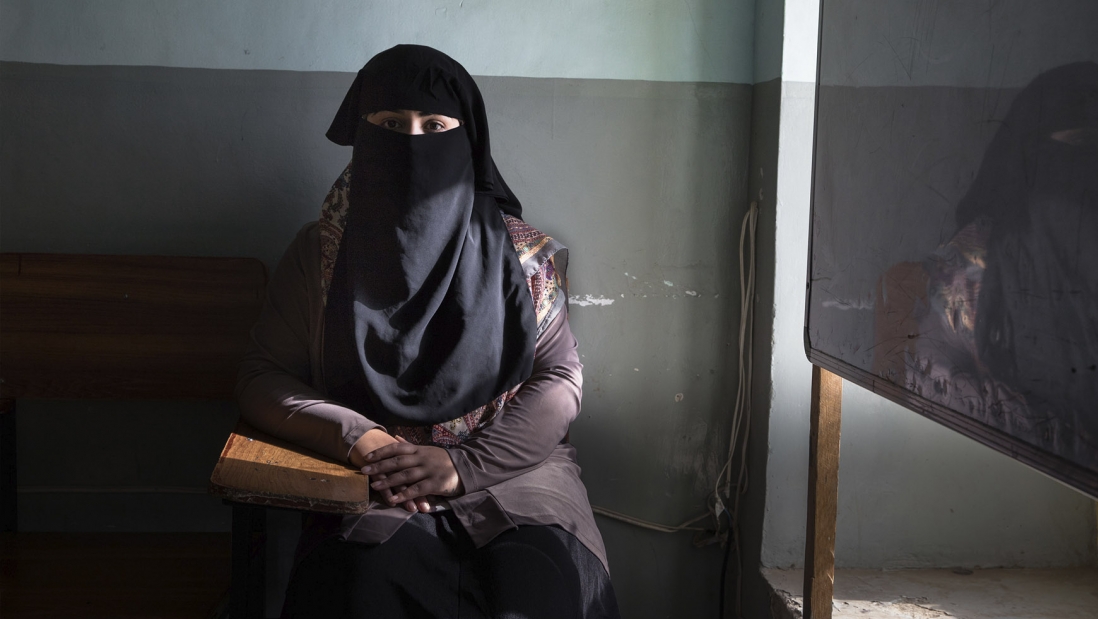
Now the schools and universities of Afghanistan are closed to girls. The sharpest minds are locked out of classrooms, waiting, growing older. Sixteen-year-olds have become eighteen, still hoping for news that the doors will open again. This dark period, I believe, will pass - but something irreversible has been lit in the hearts of Afghan women: a determination never to let go of learning.
I remember once attending a gathering where the daughters of a local khan (tribal chief) were present. They had never gone to school, and their illiteracy was their deepest regret. “If someone asks one day how far we studied,” they said, “and we have to answer not at all, what will we say then?” Perhaps now those same women are nurturing their children to chase the dreams they once lost.
At another women’s gathering, I met a woman whose face bore the fatigue of years. She lived under the tyranny of an abusive father-in-law, her life reduced to a quiet endurance. Writing became her way out. “I’ve written so much,” she told me. “Almost every day. I just don’t know where or how to publish it. Do you think I could ever find work through writing?” She had five children, yet she still attended English classes and clung to her notebooks like lifelines.
Our mothers may have been denied classrooms and books, but they never abandoned their dreams. They passed them down, quietly, persistently until they took root in us. And even now, when doors are locked and voices silenced, I know this truth remains: Afghan women will never stop learning.