

27 February 2026
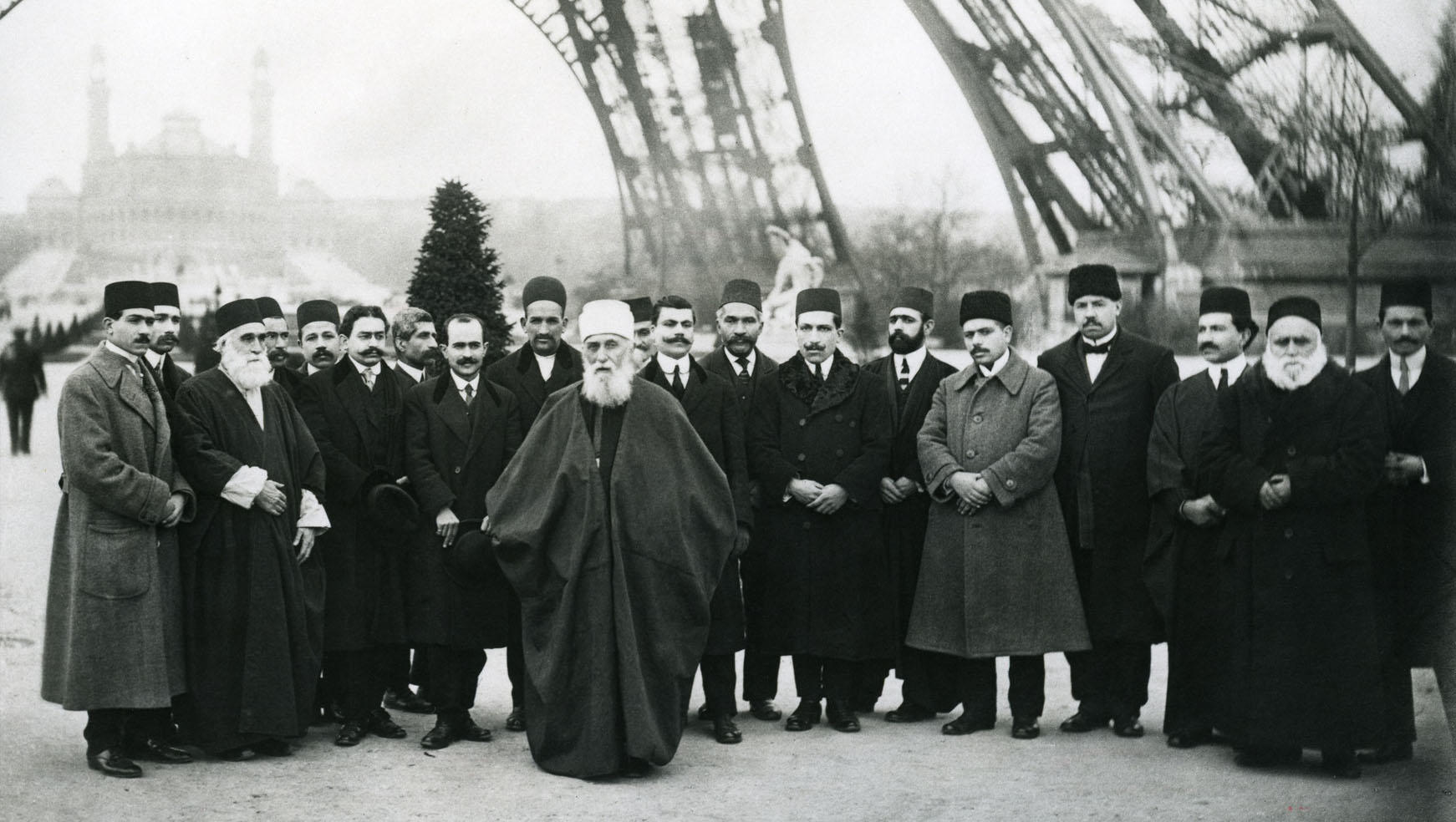
Abdu’l-Bahá on the World Stage
Iraj Ghanooni - Translated by Naeem Nabiliakbar and Adib Masumian
Iraj Ghanooni1
Translated by Naeem Nabiliakbar and Adib Masumian2
These wanderers strive day and night to establish everlasting glory for Iran and Iranians, that the noble Persian people may acquire a spectacular importance in the eyes of humanity. This was my objective in traveling to Europe.3
“Paris is exciting with respect to every matter.”4 This is the remark and the reflection of ‘Abdu’l-Bahá on Paris, on what makes Paris Paris. It is a remark acknowledged by all those who have eagerly set out for Paris. But being exciting—in every matter and respect, at that—is not wholly apparent to outward observation. Likewise, this quality of being exciting is an allusion to the spirit of Paris, to the Paris after having been experienced and understood on reflection, or to the Paris not visibly apparent, which some ardent admirers of this “global city” had believed to exist.
A city of such richness and glory as the Paris of 1911 served as the gateway of ‘Abdu’l-Bahá’s entry into Europe, this in the latter days of the Qájár era, and at the depth of the abasement of the Iranian people in the eyes of the world.
There is an irreconcilable contrast between this abasement and that glory, since the exciting yearns to extend itself—to reach beyond itself and touch what has a firmer hold on existence, not the insignificant. That which is exciting has its eye on existence and substantiality, not absurdity, nihility, and insubstantiality. In this regard, such a city as this is diametrically opposed to those left behind by the onward march of civilization—those who have nothing to say, no message or wisdom to give. The exciting city rejects you and disdains your empty- handedness, or it annihilates them both. One must have something to give, something worth giving, to gain the city’s respect.
Entry into Europe involves going through this perilous gateway, since there is the possibility that you will be accounted as nothing and disappear into thin air. The people of the exciting city are characterized by a snobbery and smugness which, though often empty, produces nonetheless an indifference that makes it difficult to interact with them, such that any Iranian who entered Paris, no matter how high his rank in the spheres of politics and culture, was paid no mind and became of no consequence. Such men would be drawn to the frenzied excitements of the city, and would at last be dissolved in them.
As a matter of fact, it is precisely because of this excitement that Iranian notables and scholars took up residence specifically in Paris, London, and Berlin. In this period, the most prominent among them, such as ‘Allámih Muḥammad Qazvíní, Siyyid Ḥasan Taqízádih, and Muḥammad- ‘Alí Furúghí, chose Paris as their residence (the first of these for a long time, the last only twenty months)—this at a time when Iranians had no cultural message to give to the Westerners. They were backward. They had lost their confidence, in fact. Following the Persian defeat at the hands of Russia when colonizing forces were dominant in the last quarter of the nineteenth century, and in consequence of the signing of the treaty of 1907 and the Persian acquiescence to Russian and British spheres of influence in the north and south (respectively), Persia became one of the subject countries of the world. And what message could the defeated and the downtrodden have for the people of the world?
For Taqízádih, total Westernization was the first order of business. The most prominent of his like-minded peers was ‘Allámih Qazvíní, who had come to Europe as a student to learn English, French, and German, and to be close to the large libraries of London, Paris, and Berlin—all this so that he could look into Persia’s past and research old texts, and eventually, over the course of many years, collate and edit the Táríkh-i-Jahángushá of Juvayní,5 a book that deals with the events of the Mongol period in Persia. In the most modern city on earth, he was living in a lost world and bygone centuries, unable to reconcile such a past with modernity, or make of them, through translation and description of the past, a lantern to light the way to the future. Despite the fact that he had lived in Europe for over thirty years, his cultural research was not oriented toward a modern world or a new cause. He was not concerned with renewal, nor could he be. The very idea of knowledge, in his view, was something merely to be stored in the mind, and for him a scholar was simply a moving library. His letters, as well as his descriptions of the Western scholars he had gone to meet, demonstrate this. One can refer to his articles and his autobiography. Qazvíní lived in Paris, that same Paris where Henri Bergson lived. In those years, Bergson, a promoter of many subtle ideas and thoughts, was idolized by the cultured; he exerted great influence on the philosophers and thinkers who succeeded him. How strange that Qazvíní had nothing to do with him or all of these happenings! This was the extent of the work of scholars like Taqízádih, Qazvíní, and Furúghí; they did not enlighten. They had gone to the West to learn a language, to read things, to go on leisurely excursions, and to enjoy the comforts of the cradle of civilization.
The erudite Muḥammad-‘Alí Furúghí was another Iranian who went to Europe, eight years after ‘Abdu’l-Bahá traveled to that continent, as the head of the Persian delegation to participate in the Paris peace conference at Versailles. He wrote about his experiences and those of his fellow delegates in one of his letters, at the end of which he regards the solution to Iran’s degradation as lying in public opinion, something that has no real existence in that country:
Iran must first gain existence so its existence can exert an influence. In order for Iran to exist, it must exist in public opinion. The existence of public opinion is dependent on a group of people, however small, being united and working, without ulterior motive, for the good of the nation.6
By his own testimony, this learned man, too, was of no consequence. Whereas eight years before that, the people of Iran and France, Bahá’í and non-Bahá’í alike, received ‘Abdu’l-Bahá warmly, Furúghí and the delegation that accompanied him, who received no stipend from Iran, resorted to paying at Parisian cafés on credit, drinking wine, and passing their days idly. The article “The Summer of 1919: A Few Iranians, Idle in Paris,”7 highlights this state of affairs well, as attested by that very letter. Thus, it is evident that we do not encounter anyone from among the Iranian contemporaries of ‘Abdu’l-Bahá who measured up in this city, or had anything to offer to the people of Europe.
Had these scholars not come on diplomatic business, as Furúghí did, at most they had come to increase their knowledge and perfect their erudition. Hence, if they had exchanged their political goals for cultural objectives, it still would not have made a difference, since they were there to receive, not to give. As attested by Reza Davari (a professor of philosophy), although Furúghí was one of the first [Iranian] translators of philosophy, he was never numbered, in any way, with eminent thinkers.8 That he should have any place in the world of thought—that he should be a productive, modern mind and influence the thinking of Parisians—was impossible.
Not so with ‘Abdu’l-Bahá. He entered the West from a position that was quite different from, and even in contrast to, the elites of Iranian culture and literature—the best of their representatives. Contrary to His countrymen, He had a message that was actually meaningful. He had the welfare and felicity of all humanity in mind. In other words, He came to incite excitement in Paris—to stir people’s hearts, their souls, their very beings to dynamism, something that no Iranian before Him, despite their best intentions and with all their capabilities, could accomplish. Yet this was not the same kind of excitement that Paris suffered from, the kind that His fellow Iranians would have wanted to create, if there were indeed such people, since only that could have been the height of their happiness and wisdom. ‘Abdu’l-Bahá must have been drawn to Paris because there was something missing in its excitement, something that fell short of the bonafide, the consummate excitement that is distinctively human.
‘Abdu’l-Bahá thus went there, not to take, but to give. Unlike His eminent compatriots, He could influence His environment, touch it and transform it, since He was not merely attracted by the superficial sights and excitements of Paris. Unlike them, He—at an advanced age, no less—had not foregone the comfort of His home for strolling and sightseeing. He certainly did not go to Paris to enjoy Himself. It was a different kind of excitement that took Him there, which He considered the root and mother of all excitement. This excitement manifested itself in a modern form, especially in the talks He gave in Paris, along the lines of the modernity which defined that city, through talks and teachings that are usually called “the Twelve Principles”—in reality, consisting of more than just twelve—which themselves can be a focal point of excitement all its own. These talks were suited to the intellectual palate of the Europeans. It is for this very reason that His attendance at the gatherings of learned ones in churches, synagogues, mosques, and universities, as One Who had much to give, was so appealing that it even attracted Henri Bergson to His presence when He traveled there a second time in January 1913, in order that he might hear His proofs of [the existence of] God— this at a time when Bergson did not believe in God. The news of this meeting was reported in newspapers and reached the attention of Nuṣratu’d-Dawlih, the son of Farmánfarmá, who at that time was studying law in Paris. He, too, requested an audience on that same occasion with ‘Abdu’l-Bahá, but arrived too late.9 ‘Abdu’l-Bahá gave talks before the luminaries of science, literature, and scholarship, and one must refer to the many articles that have been written in this vein; it is beyond the scope of this essay even to allude to them.
Contrary to other Iranians, ‘Abdu’l-Bahá did not adopt an attitude of antagonism stemming from the successive losses in the wars between Iran and Russia, as well as the humiliating treaty of 1907 signed by the Russians and the British. Defeat and humiliation reveal themselves in a language of helplessness, vengefulness, and insecurity resulting from feelings of inferiority. ‘Abdu’l-Bahá, however, chose a language that was particularly world- embracing. He endeavored to universalize His message as much as possible. It was for this very reason that He did not address “Parisians” and “Europeans,” but “the peoples of the world.” This is apparent in that, if one is to address “the peoples of the world” (the general), one must first include “the Europeans” (the specific) in one’s speech, and then ultimately merge them. Europe and America would be at once contained and blended in the universality of His addresses to “the peoples of the world.” His message took on a highly universalist tone. Under such circumstances as these, the scene changes fundamentally; it is enough to turn a situation on its head. Any sense of antagonism stemming from Iran’s historical defeats—its military losses and diplomatic concessions—evaporates.
The speaker occupies a transcendent position. The teachings and messages ‘Abdu’l-Bahá propounded did not apply exclusively to Europeans or any other group; rather, they pertained to the people of today—to people in the purest sense of the word, not only victors.
The ideas He employed in His talks rose above the ephemeral and topical interests of the day and the prevailing political strife of the time—such common divisions and segregating categorizations as “Easterner” and “Westerner.” His discourse was not one of expulsion and rejection. He typically availed Himself of ideas that were not associated with any particular religion or sect; they were universal ideas. One of these was the meaning of “life” in relation to “civilization,” which He portrays as a duality: He juxtaposes material civilization with spiritual civilization, without rejecting the former out of a misguided sense of asceticism. The Westerner had forgotten spiritual civilization, which ‘Abdu’l-Bahá in fact compares to material civilization:
Just as we work in pursuit of material civilization and strive to obtain its benefits, and just as we endeavor to acquire the means of worldly comfort and well-being, we must attach more importance to spiritual life . . . so that, even as our material existence, our spiritual life may likewise attain perfection.10
This is that same felicity that Christ wished for the people of the world—and now, through Bahá’u’lláh, a new and solid foundation for the realization of that felicity has been laid. This is that felicity in which the Parisians, with all their excitement, had no share, nor did the rest of the world. At most, Paris was the capital of modernity, and it belonged under the umbrella of material civilization; it was not opposed to it. Consequently, those same objections that could be raised [against Western civilization] were also applicable to Paris. Modernity had no place in the category of spiritual civilization—that is, no one believed in spiritual modernity, and the Europeans, freed from the fetters of religion, made no claim to any kind of renewal in the context of spiritual modernity. Rather, they were mostly trying to prepare such means as would put that kind of civilization, which they considered the epitome of backwardness, behind them once and for all. Although a century earlier, the Christian philosopher Georg Hegel had focused on the words “spirit” and “Geist” in his major work, The Phenomenology of Spirit—with all the expansiveness of meaning he had given them—even using the word “spirit” was looked on with suspicion as a result of the influence of Communism and Positivism in the nineteenth century and the early decades of the twentieth.
In his most important work, Being and Time (1927), the eminent philosopher of his day, Martin Heidegger, warns that we must be wary of certain words, one of which was “spirit.” In one instance, he even indicates that Georg Trakl also makes this same recommendation. Hence, the spirit of the age was to avoid these words and their meanings, albeit Jacques Derrida clearly shows that he himself ignored this directive and would bring them into his works here and there. At any rate, it was at such a time as this that ‘Abdu’l-Bahá spoke not just of a moral civilization, but a spiritual one, and this involved nothing short of battling the age and its spirit. It was in spite of this opposition to the spirit of the age that He secured a success which no Iranian who aligned himself with the material civilization of Paris was able to achieve.
All the excitement of Paris was born of its encounter with modernity in the realm of material civilization, which [for Parisians] represented nothing more than all of civilization itself. From the perspective of ‘Abdu’l-Bahá, something was obviously lacking—something hidden by the overwhelming power and total conspicuousness of the evidences of modern civilization. He did not speak directly of deficiency as deficiency; rather, He drew on an existing idea that was not only familiar but also acceptable to the common sense of the Europeans—a division of life into two dimensions, material and spiritual.
In reality, it was in such a milieu as this that ‘Abdu’l-Bahá spoke of the idea of “spiritual modernity,” this within the framework of opening a “world.” He spoke of that which could not be seen and was paid no mind by the artists, writers, and scholars of that age in their creative pursuits. He spoke of opening the “gates of the kingdom,” as well as the gates of a modern city and a modern world, in this, our world. These are possibilities and openings that cannot be seen with the outer eye; they must be seen with one’s insight, the inner eye, from a perspective that would enable someone to perceive the incompleteness of material civilization, since imperfection and incompleteness conjure up the ideas of their opposites. Completeness and perfection, a priori, prevail over imperfection, and it is always in relation to them that something is imperfect. “The gates of the kingdom,” along with the fresh possibilities they entail, are here open in a vista newly revealed. Christian Europeans were quite familiar with these words and their similarity to the words of Jesus—but at the same time, given their belief that the kingdom was up in heaven, ‘Abdu’l-Bahá’s phrasing allowed them to envision the gates of the kingdom being opened right here in this world, as if by removing the sky and extending our planet heavenward:
Let’s rend asunder heaven’s roof And put in place a new design!11
This vertical extension of the world, this exaltation of the earth, this unprecedented opening of the planet to the human “subject,”12 was not an assurance that they will be delivered to the “promised lands” of some merely material utopia—something promised to them more than anything else. Instead, it was an invitation to elevate their vision and behold a far more self- revealing expanse of global proportions. It was an invitation to build a world without any sign of people huddled together in a crowded place, because even though they would still have no choice but to live in the same confined space they had before, it would not be “confined” in the way they had previously thought, for it would offer a new way of life. It is an invitation to solve the problems that beset us here on earth with a broadness of vision that results from witnessing the opening of the “gates of the kingdom.”
Naturally, this is antithetical to the closing of the doors to the world of truth, prompted by the convictions of those who profess the ancient beliefs and rigid conceptions of our time: the twenty-first century. Such beliefs are imposed on minorities and the disenfranchised, and consequently justify a false and artificial religiosity. True religiosity suffers as a result, and the majority consent to disregarding the right of minorities to practice their religion according to the circumstances of the time. No other justification accounts for this metamorphosis in the essence of religions—that institutions which, at the time of their founding, were established to negate whatever was vain and false have, at the time of their decline, become satisfied with the bare minimum and content even to mislead their followers completely. Truly, the opportunities for human salvation are dwindling away. Since, contrary to the tiding of ‘Abdu’l-Bahá, the gates of paradise have not opened, but are in fact closing, we may well hear these words from today’s leaders of religion: “O misbelievers and heretics! You must resort, by any means necessary, to changing your religion—or at least pretending to do so— for it is we who guarantee your place either in heaven or hell!” It falls on the masses, in other words, to accept a burden that is weighty, yet also out of place.
To promise the opening of the “gates of the kingdom” in the context of material civilization to the modern person is not, nor has it ever been, to invite them to accept an illusion. Rather, it is to draw their attention to a point that cannot be foreign to them with respect to their position and proficiency because they are a creator. As Heidegger has pointed out, creation means “to establish in Being something that does not yet exist.”13 The merit and pride of a creator thus consist in making previously unknown connections and bringing into Being what “does not yet exist.” Otherwise, what one does is not creation. The eyes of ‘Abdu’l-Bahá were set on this proficiency of the modern person, summoning them to a higher plane—to a mode of being that does not yet exist—so that they might behold new possibilities and new methods may occur to them.
In presenting His mission in Europe, ‘Abdu’l-Bahá refrained altogether from using such dichotomous language as “backward” and “advanced.” It is obvious that the Europeans have made advances. This advancement, however, has fixed specifications; it has its own boundaries, restricted to material civilization and everything that pertains to it. ‘Abdu’l-Bahá calls this by a name to give it value. It is the Europeans’ way of life and their outlook on it which are the objects of His fundamental criticism. In the aforementioned talk, He refers to Jesus Christ as a founder of spiritual civilization in the distant past, and adds that, like Him, Bahá’u’lláh has now laid such a foundation. It is evident that, in mentioning the name of Bahá’u’lláh, the attention of ‘Abdu’l-Bahá’s audience would immediately be turned to Iran, since that is where He founded this religion. The Europeans were behind when it came to spiritual civilization, and from His perspective, their backwardness was in something more basic: “Your cup is empty of that wine it ought to have.”14 This dichotomy is itself a criticism of the one-dimensionality and incompleteness of modernity.
Broaching the subject of spiritual civilization in contrast to material civilization also entails that the persisting incompleteness of modernity is a quality inherent to it, derived by the limitedness of its scope and sphere of action. It will, therefore, remain incomplete, and there is no recourse but to add a spiritual dimension to the material one. Where in essence there is incompleteness and imperfection, one cannot achieve the perfection and felicity of humanity. A Person reared with such a spiritual upbringing as this had come from Iran, and unlike other Iranians, who looked on the advancements of Westerners with fascination and astonishment, ‘Abdu’l-Bahá, while acknowledging these strides they had made, spoke at the same time of their backwardness on a fundamental level. It is in this setting that His message was crafted— in seeing everything correctly and keenly, and rightly turning to the imperfections. This “message” belongs to One Who has His own unique way of looking at things.
In the discourse of ‘Abdu’l-Bahá, the message, in fact, transcends the people He was addressing at that moment. It goes beyond the confines of continents, and even place altogether, and reaches out across time. ‘Abdu’l-Bahá’s message was not intended for His attending audience or the people of the world at that time; rather, it was a message for all periods—at times even a message from bygone ages, making reference to all the divine religions—but with a new interpretation of them. For example, in a talk He gave in Paris on 13 November 1911, He says:
The foundation laid by Bahá’u’lláh is the renouncement of national, religious, racial, and political prejudice, inasmuch as the world has been afflicted with the illness of prejudice—a chronic illness that will result in death.15
He refers to this teaching of Bahá’u’lláh as one of the essential tenets of all the divine religions, saying, “If the followers of religion are followers of God and obedient to the divine teachings, those teachings command them not to have any prejudice whatsoever.”16 This certainly surprised His European audience; until then, they had not heard such a teaching from the mouth of any member of the clergy. How could this be the teaching of all religions?! But ‘Abdu’l-Bahá argues rationally that this is one of the essential tenets of the divine religions: “. . . inasmuch as the divine teachings explicitly state that the members of the human race must deal lovingly with one another.”17 Christians would accept this principle, but what about Muslims? Hence, in continuing His theme, ‘Abdu’l-Bahá gravitated toward the foundation of the principle of love which has been emphasized in Islam, and in particular Sufism: “Every fault one has, one must see in one’s own self, not in another, and one must never prefer oneself over another.”18 Since the command to renounce selfishness has been given, consequently, ‘Abdu’l-Bahá has also placed emphasis on the principle of love in Islam. Beyond this, He gives a rational argument here:
. . . for none knows what one’s own end shall be. How many are the people who were pious in the beginning and then strayed from that path, such as Judas Iscariot, who at first was very good but in the end became very bad, and how many are those who at first were very bad but in the end became very good, like the Apostle Paul, who at the outset was an enemy of Jesus Christ and ultimately became His greatest servant! Hence, one does not know what one’s state will be at the end of one’s life. This being the case, how can one prefer oneself over another? Thus . . . let one not say, “I am a believer, while so-and-so is an infidel!” or, “I am near the threshold of the Almighty, while that one is rejected from it!”19
And this is not all, for if one does have such a preference and the sense of superiority that comes with it, it is both out of ignorance and in ignorance that one has it. One must, therefore, do away with it. Haven’t all religions appeared to bring knowledge to humanity? It must be borne in mind that, when it comes to the thing called “ignorance,” ‘Abdu’l-Bahá intentionally refrained from elaborating on examples of it, lest by this means they be overly emphasized or given undue importance—yet from the context of this talk, it is clear that this ignorance consists of the realities that have justified racial and ethnic prejudices, thus laying the groundwork for people to make negative judgments. ‘Abdu’l-Bahá does not say things like, “Such-and-such people are immoral and have a culture which is in decline; they have a low social consciousness, and one cannot mingle with them.” Of course, all of this means that these people are ignorant, and it is at this very juncture that He reminds them of a responsibility that has been underscored in all religions:
Secondly, one must strive to impart knowledge to those who are without it. One must help the ignorant children to reach the age of maturity and make pleasant the disposition of the ill-tempered. One ought not to feel enmity toward such a person as this; rather, one must guide them with the utmost love.20
In not elaborating on this point, it is clear that ‘Abdu’l-Bahá is choosing to look the other way, since the process of education is a long one. Hence, it is that willingness to overlook which must take precedence, since looking the other way here means that a chance is being given.
Following this, in criticizing the prejudices of race and nation, as well as special privileges enjoyed by particular countries, He refers to all such exclusionary demarcations as running counter to divine creation:
We are all people; all of us are descended from Adam. Given this oneness of humanity,21 how can we put ourselves at odds by saying, “This person is German, and that one is English; this person is French, and that one is Turkish; this person is Rumelian, and that one is Iranian”? This is sheer illusion.22 Is it permissible to engage in conflict and contention over an illusion?23
Eventually, after not lending any credence to these distinctions, such as racial distinctions, ‘Abdu’l-Bahá points to that which is the basis of all religions, observing that this alone is what results in the elimination of prejudices:
Therefore, the true distinctions among people consist in their morality, their virtue, their love, and their understanding, not in their being Eastern or Western.24
In this way, by referring to each and every one of these principles accepted by all religions, ‘Abdu’l-Bahá established them as the essential tenets of true religiosity, despite the fact that it was Bahá’u’lláh Who had exclusively articulated them. Through ‘Abdu’l-Bahá’s contextualization, and with His manner of rational argument, He made these principles incumbent on everyone to follow. This approach implies that we do not tell people to become Bahá’ís; rather, no matter what religion one belongs to—or even if one does not belong to any religion at all—one ought to practice these teachings nonetheless, saying in essence, “If you want to be free of religion, at least bind yourselves to virtue.”
It is clear that no one until that time regarded this teaching as being connected to any of the religions. No minister, no mullah, no rabbi considered it to be one of the divine teachings. Yet, none of them could oppose this rational conclusion. The universalizing approach of ‘Abdu’l- Bahá, which not only allows but brings others into the fold, stands in stark contrast to the behavior of the people of the world, especially His Iranian compatriots, in that He opened a salvific umbrella over the heads of all humanity that transcends continents and connects religions to one another.
The brilliance of ‘Abdu’l-Bahá’s reasoning lies in the simplicity and undeniability of its self- evident elements. The listener has no choice but to accept His propositions, one after the other, eventually culminating in this point: that morality, the acquisition of virtues, and love are necessary tenets of all religions. It’s as simple as that! There are no complicated concepts or ideas at work here—and that fact, more than anything else, could have reminded the intellectuals of Paris of the Discourse on Method of Descartes, who considered self-evidence, simplicity, and clarity to be the basis of his method. Among the things he said were that he learned to commence logical propositions “with objects the simplest and easiest to know,”25 and he emphasized not to mingle “correct and very excellent precepts”26 with those that are “injurious or superfluous,”27 inasmuch as “it is almost quite as difficult to effect a severance of the true from the false as it is to extract a Diana or a Minerva from a rough block of marble.”28 Or take the rule of Descartes in that same book “to divide each of the difficulties under examination into as many parts as possible, and as might be necessary for its adequate solution.”29
‘Abdu’l-Bahá had not read Discourse on Method, and His education was limited to one or two years’ worth of traditional schooling in Iran, but He adopted a method that the Parisians happened to be familiar with. Hence, He began His discourse with self-evident truths like “love is light, no matter in what abode it dwelleth,”30 or “O respected gathering! Burning is an inherent property of fire, and igniting an innate characteristic of lightning.”31 He would establish, for example, that change is an essential property of the contingent world—which is self-evident—then conclude that among the manifestations of such change are the decline and destruction of religions in morality and spiritual radiance, following the lofty condition they once enjoyed. ‘Abdu’l-Bahá would divide His topics into parts. One of the most important instances of this was His presentation of the Bahá’í social teachings, despite the fact that scholars in the East at that time were not accustomed to using such methods, and ‘Abdu’l- Bahá himself had not had any training in making these kinds of presentations. He would present the teachings without attaching any importance to the sequence of His enumeration, often putting the teachings in different orders. Although He would always speak of twelve principles, at times He would add one topic and leave out another. The way in which He organized them was fluid. The result was the same self-evidence and clarity that that great French philosopher had cherished—and more than just that, it was an effort to unfetter people’s minds.
In this way, ‘Abdu’l-Bahá enlightened hearts and minds with that which is evident and lofty. The way He expressed His views was suited to the capacity of His European audience and the frameworks they were familiar with. Where words are clear, lofty, and liberating, they have the power to ignite, and are thus naturally exciting. Such words first burn themselves up and disappear into thin air, and then cause others to catch fire. These characteristics shed light on the matter32 of words, which is to say words as mere signifiers, and substantially reduce the listener’s involvement with those signifiers. Those who attended His talks would not have any engagement with words on a superficial level; they would be led directly to their meanings, and come to feel lightness and excitement. They saw no need to resist these self- evident truths and felt no burden on their souls. They went along with what they heard.
What is necessitated by such a presentation as ‘Abdu’l-Bahá’s are the distinguishing of social teachings in the Bahá’í Writings—taking care not to mix or confuse them with theology, fundamental verities, and philosophical tenets—and, at the same time, a comprehensive knowledge of these principles and the ability to infer social teachings from core beliefs. ‘Abdu’l-Bahá’s was the soundest, the most methodical, and the most precise articulation of Bahá’u’lláh’s objective for the society of that time in the West. In His discourse on social teachings, His audience saw themselves more than anything else, as well as their concerns pertaining to that time and place, and thus drew closer to the Speaker and His intent. They saw that He was speaking of their time, and that He was concerned with the needs of the age they lived in.33 It can clearly be seen that this Cartesian rule, which in reality is the rule of a sound mind, is observed by default in His talks—that one must strive:
. . . to conduct [one’s] thoughts in such order that, by commencing with objects the simplest and easiest to know, [one] might ascend by little and little, and, as it were, step by step, to the knowledge of the more complex; assigning in thought a certain order even to those objects which in their own nature do not stand in a relation of antecedence and sequence.”34
‘Abdu’l-Bahá would often utilize axioms that were self-evident and undeniable, yet forgotten in the Western tradition. Through rational argument, for instance, He would ask how it can be that, when one murders another, one is called a murderer, but when one kills an entire people or nation, one is called a conquering commander. Educated Europeans were astonished at the forgotten reasoning behind this discourse, which in fact Cato, the Roman orator and statesman, had first used centuries ago. ‘Abdu’l-Bahá was aware of this rhetoric and employed it in His own talks, which were short and simple. The convoluted and pedantic discussions common to the gatherings of intellectuals were nowhere to be found in these talks. ‘Abdu’l- Bahá’s phrases were concise and easy to understand so His interpreters could convey them. Through the presence of these interpreters, His audience was able to follow the points He was making, thus lessening the burden caused by their occasional interruptions of the clear flow of the truths and knowledge He was expounding.
Another Western technique ‘Abdu’l-Bahá used was the lofty and morally instructive style of Christ’s speech through figurative language, starting with the most basic verities. (For a sufficient example, refer to the Sermon on the Mount.) The language of allegory is the language of metaphor and allusion. On 8 November 1911, while in Paris, He spoke about water—about water and love, love and the essence of religion, the essence of religion and the most important developments in the various creeds—this in stark contrast to the fire ignited through the vindictive interpretations of the suicidal fundamentalists of our world in this age of terror and murder. His talks mostly begin with the simplest facts and events; for instance, about how water is in the essence of all things:
The human, the animal, the vegetable, and even the mineral all depend on water for
their life. Even the mineral derives its life from frozen limpid water, and this is one of the recent discoveries . . . Thus, the source of life is water, and it is for this reason that [in the Gospel] Christ has said one must be baptized with water and with the [Holy] Spirit . . .35 It is explicitly stated in the Qur’án, “We made every living thing from water,”36 and this is almost identical to what was said above: “the source of life is water.” Hence, where Muslims are concerned, or those who come from a Muslim background like the Eastern Bahá’ís in attendance at those gatherings—and we who are present today, since the discourse of ‘Abdu’l- Bahá was also addressed, in advance, to us in the future—the attention of both His contemporary and subsequent audiences is drawn, from the very beginning, to the link between these two religions. The Qur’án and the Gospel speak the same language. ‘Abdu’l- Bahá speaks of water and mercy rather than fire, even interpreting fire as water and referring to it as such. His talk continues with reference to the practice of baptism in Christianity:
He states that one must be baptized with water and with the [Holy] Spirit—in other words, that which is the cause of eternal life—and that water is the same as fire, which is to say the love of God, for since the love of God burns away the veils, it is called fire, and since it causes life, it is called water.37
It is in this vein that He continues this analogy of water and makes no mention of sin. This is contrary to what is said in Christianity, in which the purpose of baptism is to wash away the original sin with which every Christian is burdened, which they themselves did not commit— rather it is their progenitors, Adam and Eve, who committed it in Eden—thus making it the sin of others, not our own. This misinterpretation in Christianity associates the water in baptism with sin, and in fact wastes the true symbolism of water, the most delicate of metaphors and elements of nature. No wonder Nietzsche saw so much hostility in this (mis)interpretation and why, especially in his On the Genealogy of Morality, he pursues this vein of hostility so mercilessly in many instances. Frederick Copleston, the author of A History of Philosophy, gives some responses to Nietzsche that are mostly unconvincing and pointless, but the evidences of this hostility are apparent everywhere. Even Christ was crucified to wash away the sins of Christians—one killed for the sin of another. What hostility! And this has taken firm root in Christianity, as well as its concepts and ideas.
We find it strange that, when a suicide bomber kills innocent Europeans in the Middle East for the sin of Western belligerents elsewhere, the finger is pointed only at Islam, notwithstanding the fact that the interpretation by the Christian clergy, which portrays one’s death for the sins of others as something natural, was first established in Christianity. The difference, however, is that in Christianity, one is killed, whereas in Islam, one does the killing—but when one accepts that a person can be killed for the sins of others, one can also kill for that same reason. Hence, it becomes acceptable to kill one for the sins of others. This is the unintended consequence of the doctrine that Jesus died for our sins. This is the metaphysical foundation of an unacceptable justification of the greatest martyrdom in Christianity. The personal nature of sin—or, as Ḥáfiẓ put it, the idea that “the sins of others will not be ascribed to you”38—is a major legal principle in Islam.39 If Islamic fundamentalists engage in indiscriminate killing based on a few precepts from the Qur’án and their completely erroneous interpretations of those precepts which pertain to the infidels, in Christianity the principle of the personal nature of sin in the theology of this religion is weakened on a far more fundamental level, because religious laws are based on theology and have no basis in and of themselves. Islamic jurisprudents and scholars of religious law can stop the execution of laws (especially in Islam) for some exigency or other, or choose not to carry out those laws for certain reasons—but theological concepts are so fundamental, so inseparable, that they are applied entirely and without interruption.
At any rate, the principle that one cannot be punished for the sins of others is one that was first trampled underfoot in Christianity, and now, in our world today, in the fundamentalist and extremist variety of Islam. This religious teaching, that killing one for the sins of others is not such an irrational proposition, is internalized in the mind of a Christian believer from the very beginning. All this sin and hostility that Nietzsche saw in the roots of Christianity, the religion of peace, is turned on its head in ‘Abdu’l-Bahá’s aforementioned talk, and through this inversion, the essence of all religions is manifested. The elements of water and spirit in baptism join forces; they give eternal life and are interpreted together. Here, water is no longer meant to wash away the stain of sin. Why should it? Why should everyone be looked upon, a priori, as sinners? No, in ‘Abdu’l-Bahá’s talk, water is interpreted as love. In His interpretation—expressed in a talk on water, the water of the love of God—this lost meaning is brought back to life. Before this, however, He says:
That water is the same as fire, which is to say the love of God, for since the love of God burns away the veils, it is called fire, and since it causes life, it is called water.40
Love is exciting, vivifying, and this was suited to the taste of the Parisians. It is excitement that burns the veils of separation and brings people closer to one another, strengthening them in so doing. Had it not been for this resilient excitement, Abraham, Joseph, Moses, Jesus, Muḥammad, the Báb, and Bahá’u’lláh—as ‘Abdu’l-Bahá goes on to say in His talk—would not have resisted the injustices of their respective peoples; they would not have had the strength to withstand them, a strength which closeness had given them. Their steadfast resistance was actuated by the love of God, the purest and deepest display of human affection by Those Who were ceaselessly roused to carry out Their missions in relation to their peoples. That is, the love of God initiates a love for humanity, a love that excludes nothing, encompassing even Their enemies and the truth—a love in the truest sense of the word, universal and all- inclusive. This was a love that had the power to create, not just paintings, poems, or abstract notions in a work of literature or philosophy, rather something far above these—a love that created the greatness of humanity and bestowed it on us. How can one deny that it is the greatness of humanity which comes first, and its creativity and the fruits thereof which follow?
This was the sort of excitement that Paris lacked. But in this metaphor, fire is pulled back immediately in favor of water, and from this point onward, as was the case before, it is water that flows in ‘Abdu’l-Bahá’s talk: “. . . since [the love of God] causes life, it is called water.”41 The fact of the matter is that all are thirsting for water, but when one thirsts for the love of God, one does not feel it instinctively, perceptibly, consciously, as one would with actual water, for if this had been so, there would have been no need for ‘Abdu’l-Bahá to be in Paris.
What we have here is not the thirst of the body, it is the thirst of the soul, and because this thirst is not felt instinctively, an educator is needed—an educator who is close by and strengthened through nearness both to the soul itself and the soul of the world, one who has insight into the reality of humanity and the myriad layers of its characteristics. ‘Abdu’l-Bahá had this strength and the power to cause excitement, the loftiest and most enduring kind of excitement. His mission in Paris, and then the rest of His tour to Europe and America—the “world stage”—was that of an educator. The talk then continues thus:
The love of God is the reality underlying the virtues of humanity; with it, the nature of mankind is made pure. Through the love of God, one is delivered from the imperfections of the world of humanity.42
The topic at hand here is imperfection, which is inherent to human existence, not sins or wrongdoing. ‘Abdu’l-Bahá continues: With the love of God, one progresses in the realm of virtue. The love of God causes the world to be illumined, and brings about the unity of all mankind.43
Use of the word “religion” has clearly been withheld here. No one is asked to become a Bahá’í; it is to the essence of religion—that is, the love of God, the one and only religion—that everyone is invited, regardless of their views, attachments, and affiliations, since if religion and religiosity are bereft of the love of God, they have little worth.
In continuing His line of thought, ‘Abdu’l-Bahá makes a connection with water, which renews and refreshes, that allows Him to link the essences of all the religions together:
The love of God is the truth of all religions . . . it is through the love of God that Abraham destroyed the idols . . . it is through the love of God that Joseph became the ruler of Egypt.44
It is also out of this point of origin that all the important actions and endeavors of the Prophets arose:
It is through the love of God that Christ conferred eternal life. It is through the love of God that Muḥammad lifted the Arab people from the lowest depths of ignorance up to the loftiest heights of knowledge.45
Hence, all religions are one—the religion of love—but it is the worlds in which each of them appeared that differ from one another. The whole talk is one arc. In its underlying structure, at its base, the existence of lower beings is established to derive from material water. Yet at the peak of the arc, humanity, being the noblest and loftiest of creatures, is sustained by the water of love in spiritual, and not merely material, life. The arc begins with material water and culminates in spiritual water, which sustains the life of the soul. Throughout the entirety of ‘Abdu’l-Bahá’s talk, it is this water that flows without any accusation of sin. There is no blame at work here. It is the simplest of things, water and its fluidity, that His audience is asked to follow.
In conclusion, if we wanted to take ‘Abdu’l-Bahá as an example of a cultured Iranian—that is, if a European, a Parisian, listening to Him in the audience were to deduce that other Iranians must be similar (more or less) to ‘Abdu’l-Bahá—we would have to call that an unsound inference, and in fact declare it a false analogy. He was not a representative of the Iran of His time, notwithstanding that He was a true Iranian, and thus naturally a representative of that
nation. What ‘Abdu’l-Bahá represented was the Iran of the future, not the culturally depleted and degraded Iran of His day. In other words, He was not at all a product of the Iran of His time. There was an enormous gap between Him and that Iran.
The short space of this essay only allowed for an analysis of just two of His talks, so as to familiarize ourselves with His ideas and thoughts, as well as His rhetorical style, all without precedent among other Iranians. A culture in decline does not build ideals, nor does it have many worthwhile ideas to give, except for abstract notions that have no basis in the real world.
There was, however, a real ideal by the name of ‘Abdu’l-Bahá. His ideas were not abstract, and this was a thing without like or peer among Iranian scholars, as He Himself would go on to point out:
Not a word of these teachings was heard in Persia before the appearance of Bahá’u’lláh. Investigate this matter so that it may become to you evident and manifest.46
At the beginning of the twentieth century, Parisians, and then other Westerners in Europe and America, encountered an ideal Iranian, and came face to face with a Figure Who transcended all frame of reference.
This was Someone Who illustrated His novel ideas and views in a way that was splendidly suited to the modern person.
This was Someone Who could appear on the world stage. In this, there was no one like Him.
1 Iraj Ghanooni is a translator, researcher of philosophy, and the author of Kalamih va Chíz-há [“Words and Things”] and Nivishtih-í baráy-i-Khudam [“A Writing for Myself”]. He has rendered works from Jacques Derrida, Martin Heidegger, Ludwig Wittgenstein, and Bertrand Russell into Persian.
2 This article, dated 11 June 2017, was originally published with the title ‘Abdu’l-Bahá dar “Anjuman-i-‘Álam” in Erfan Sabeti (ed.), Á’ín-i-Bahá’í: Jámi‘ih, Síyásat (aasoo: Santa Monica, California, 1399 Shamsí [2020]), pp. 105– 120. The present translators are grateful to Joshua D.T. Hall, who kindly reviewed the translation with reference to the original text and offered many valuable suggestions for improvement.
3 Passage from a Tablet of ‘Abdu’l-Bahá published in Vahid Rafati, Ma’ákhidh-i-Ash‘ar dar Áthár-i-Bahá’í [“The Sources for Poetry Used in the Bahá’í Writings”] (Persian Institute for Bahá’í Studies: Dundas, Ontario, Canada, 1995), vol. 2, p. 305. Provisional rendering by the present translators.
4 Passage from a Tablet of ‘Abdu’l-Bahá published in Makátíb-i-Ḥaḍrat-i-‘Abdu’l-Bahá [“The Writings of ‘Abdu’l- Bahá”] (Faraju’lláh Zakíyyu’l-Kurdí: Egypt, 1921), vol. 3, p. 341. Provisional rendering by the present translators.
5 Author’s note: Qazvíní spent nine years on this work and did not finish it until after he had returned from Berlin.
6 Maqálát-i-Furúghí, vol. 1 (Tehran: Intishárát-i-Tús (3rd ed.), 2008), p. 79.
7 Tábistán-i-1919: Chand Írání, ‘Alláf dar Párís. BBC Persian, 4 July 2014. Accessible online at:
http://www.bbc.com/persian/world/2014/07/140702_l44_ww1_iran_treaty_versailles
8 Author’s note: Davari writes, “In my opinion, if Furúghí had not written The History of Philosophy in Europe, he would not have the fame and credibility he enjoys today. Despite all its benefits, this book has neither the faintest glimmers of thought, nor does it invite anyone to think. Our modernist history is not at all a history of [how] thought [is developed]; it is a history of learning and teaching knowledge that has already been gained. In the modern age, we have paid more attention to knowledge that is merely taught and learned; it is the science and scholarship of the Europeans that we have learned” (Táríkh-i-Tajaddud-Ma’ábíy-i-Má, Táríkh-i-Tafakkur Níst / Furúghí Fílsúf Nabúd [“Our Modernist History is Not A History of Thought / Furúghí Was Not a Philosopher”]. Mehr News Agency, 27 May 2017. Accessible online at: http://www.mehrnews.com/news/3980569).
9 Jan Jasion, ‘Abdu’l-Bahá in France, 1911 & 1913 (Paris: Éditions baháʼíes France, 2016), p. 302.
10 Khiṭábát-i-Ḥaḍrat-i-‘Abdu’l-Bahá, vol. 1 (n.p.: Cairo, Egypt, 1921), p. 93. Provisional rendering by the present translators.
11 A hemistich from ghazal no. 374 by Ḥáfiẓ: https://ganjoor.net/hafez/ghazal/sh374. The present translators are grateful to Joshua D.T. Hall for providing them with this rendering.
12 “A being that undergoes personal conscious or unconscious experience of itself and of the world” (The American Heritage Dictionary).
13 Martin Heidegger, David Farrell Krell (trans.), Nietzsche, vol. 1 (San Francisco: HarperSanFrancisco, 1991), p. 69.
14 A line from Khush bih Ḥál-i-Ghunchih-háy-i-Nímih-báz [“Well is it with the Half-Blossomed Buds”], a poem by Fereydoon Moshiri. It should be said here that, in Persian literature, wine often has a spiritual and more sublime symbolism to it (note how often it appears in the Bahá’í Writings) than is typically found in Western contexts.
15 Khiṭábát, vol. 1, pp. 158–59. Provisional rendering by the present translators. 16 ibid., p. 159. Provisional rendering by the present translators.
17 ibid. Provisional rendering by the present translators.
18 ibid. Provisional rendering by the present translators.
19 ibid., pp. 159–60. Provisional rendering by the present translators.
20 ibid., p. 160. Provisional rendering by the present translators.
21 Author’s note: It should be noted that this is the first time someone has elaborated on the concept of the unity of mankind—that its prerequisites and ramifications have been expounded to this extent and correlated to various topics.
22 Author’s note: At this time of global terrorism, however, we see that this very illusion is the basis of discrimination, and that discrimination, in turn, is the basis of terror.
23 Khiṭábát, vol. 1, p. 160. Provisional rendering by the present translators.
24 ibid., p. 161. Provisional rendering by the present translators.
25 René Descartes, John Veitch (trans.), Discourse on the Method of Rightly Conducting the Reason, and Seeking
Truth in the Sciences (The Open Court Publishing Company: Chicago, 1938), p. 20. 26 ibid., p. 18.
27 ibid.
28 ibid.
29 ibid., p. 19.
30 ‘Abdu’l-Bahá, Selections from the Writings of ‘Abdu’l-Bahá (Bahá’í World Centre: Haifa, Israel, 1982), no, 1, p. 3. 31 Khiṭábát, vol. 1, p. 29. Provisional rendering by the present translators.
32 “In Aristotelian and Scholastic use, that which is in itself undifferentiated and formless and which, as the subject of change and development, receives form and becomes substance” (The American Heritage Dictionary).
33 A paraphrase of a passage from Gleanings from the Writings of Bahá’u’lláh, CVI.
34 René Descartes, John Veitch (trans.), Discourse, p. 19.
35 Khiṭábát, vol. 1, p. 125. Provisional rendering by the present translators.
36 Qur’án 21:30. Translation taken from Seyyed Hossein Nasr, et al., The Study Quran (New York: HarperCollins
Publishers, 2015), p. 815.
37 Khiṭábát, vol. 1, pp. 125–26. Provisional rendering by the present translators.
38 A reference to the opening verse of ghazal no. 80 by Ḥáfiẓ:
Fault not the rogues their immorality,
O sainted man so pure of soul! I swear—
The Lord shall not put others’ sins on thee, And their misdeeds thy record shall not bear.
(Source: https://ganjoor.net/hafez/ghazal/sh80; translation by Joshua D.T. Hall, quoted here with permission and gratitude.)
39 cf. Qur’án 35:18.
40 Khiṭábát, vol. 1, pp. 125–26. Provisional rendering by the present translators.
41 ibid. Provisional rendering by the present translators.
42 ibid., p. 126. Provisional rendering by the present translators.
43 ibid. Provisional rendering by the present translators.
44 ibid. Provisional rendering by the present translators.
45 ibid., pp. 126–27. Provisional rendering by the present translators.
46 ‘Abdu’l-Bahá, First Tablet to the Hague – 17 December 1919, 33. Available online here: http://www.bahai.org/r/726030316.